
Merge Queues: Keeping Approved Work Moving as Main Changes
Approval is a checkpoint. A busy target branch can change what happens next.
On this page
Two pull requests pass their checks against the same version of the target branch. The first changes a shared interface. The second still assumes the old interface exists.
Both authors may have done good work. The integration question has changed because the branch they intend to join has changed. A merge queue gives teams an orderly way to manage that transition instead of relying on whoever clicks first.
Define what entering the queue means
Being ready for a queue should mean the change has met the team's entry criteria. Those criteria might include required reviews, relevant automated tests, resolved discussions, and any necessary release coordination.
Write the rules down. A queue should not become a place to park incomplete work and hope someone notices. It should also not bypass a deliberate decision about a risky change simply because a collection of automated checks is green.
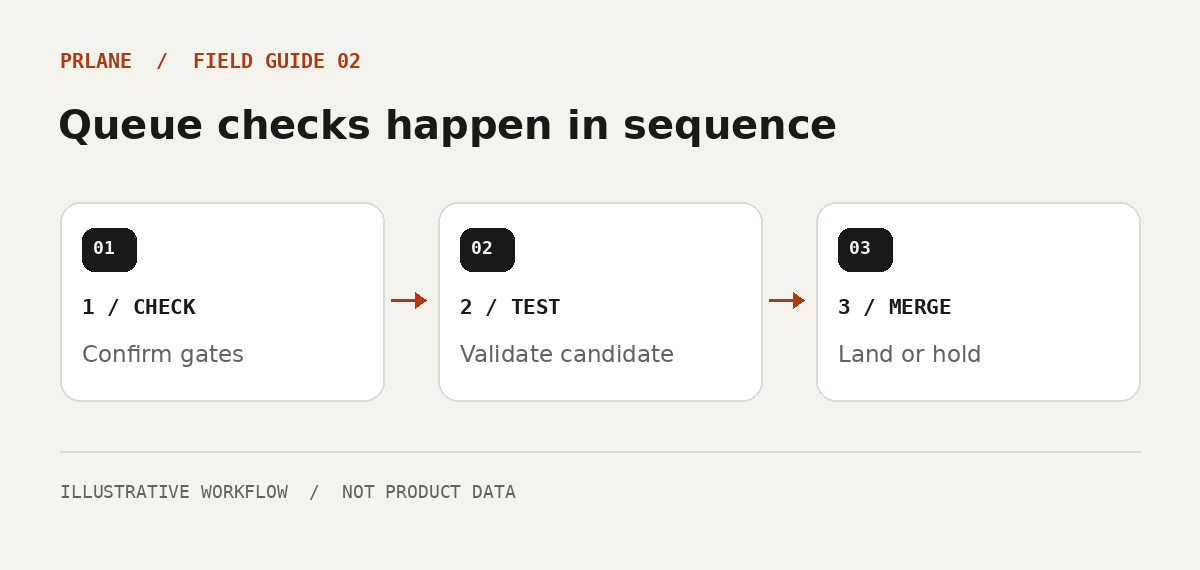
PRLane's merge workflow includes checks immediately before merging, covering the approved commit, check results, reviews, conflicts, and branch protections. The engineering team still owns the acceptance standard.
Separate the jobs of review, CI, and the queue
These mechanisms answer related but different questions:
- Review: Does the proposed change make sense, and have its tradeoffs been considered?
- CI: Does this tested version satisfy the checks the team has defined?
- Queue coordination: Is this change still eligible to proceed at the point it reaches the front?
None can prove everything about production behavior. A passing test suite cannot cover a requirement nobody captured. An approval does not make a later, materially changed commit equivalent to the one a reviewer examined.
That is why changed code and changed branch context deserve fresh attention. Decide which changes require another review and which tests must run before the work can proceed.
Treat a stopped queue as information
Imagine a hypothetical batch containing a configuration cleanup, an API refactor, and a client update. The refactor exposes a failing integration check after the first change lands.
Do not repeatedly retry the entire batch without understanding the failure. Record which commit failed, which check produced the evidence, and whether the problem is a code regression, environmental issue, or unclear dependency.
Assign an owner to the next action. If you remove or defer the problematic change, preserve its original context and review the effect on anything depending on it. Moving the blockage out of sight is not the same as resolving it.
Keep queue policy understandable
Teams need a clear answer to practical questions: Can an urgent fix move ahead? Who may change the order? What happens when a branch changes after approval? When does a failed check require investigation rather than a retry?
Prefer a small number of rules that people can explain. Exceptions should have a reason and an accountable decision-maker, especially when the change touches authentication, billing, or shared infrastructure.
Watch the actual bottleneck
Measure time before queue entry separately from time spent inside it. Long waits for initial review will not disappear because the merge step is better organized. Long CI runs may remain the limiting factor after approvals become faster.
Use those observations to improve the next constraint. The goal is a predictable route from an accepted change to integration, with evidence that remains relevant along the way.
Related guide: Bulk merging needs guardrails, not just a bigger button.
Sign up for PRLane to manage your PR fleet and merge workflow.