
A Practical Kanban Triage Routine for Pull Requests
A useful PR board tells someone what to do next, not just where a card sits.
On this page
A pull request board can become a colorful version of an unread inbox. Cards accumulate, columns acquire vague names, and the team still asks the same question in chat: “What is this waiting on?”
Kanban becomes useful when each state communicates a decision. For pull requests, that means separating work that is still being written from work waiting for review, fixes, or integration. The board should reduce investigation, not add another administrative task.
Define states by their exit conditions
Start with a small set of states and explain what lets a PR leave each one:
- Draft: The author completes the agreed scope and requests review.
- Needs review: The appropriate reviewer makes a decision or asks for changes.
- Needs attention: An identified owner resolves a specific failure, conflict, or open question.
- Ready: The change satisfies the team's requirements for the next integration step.
- Queued: The change is waiting in an explicit integration order.
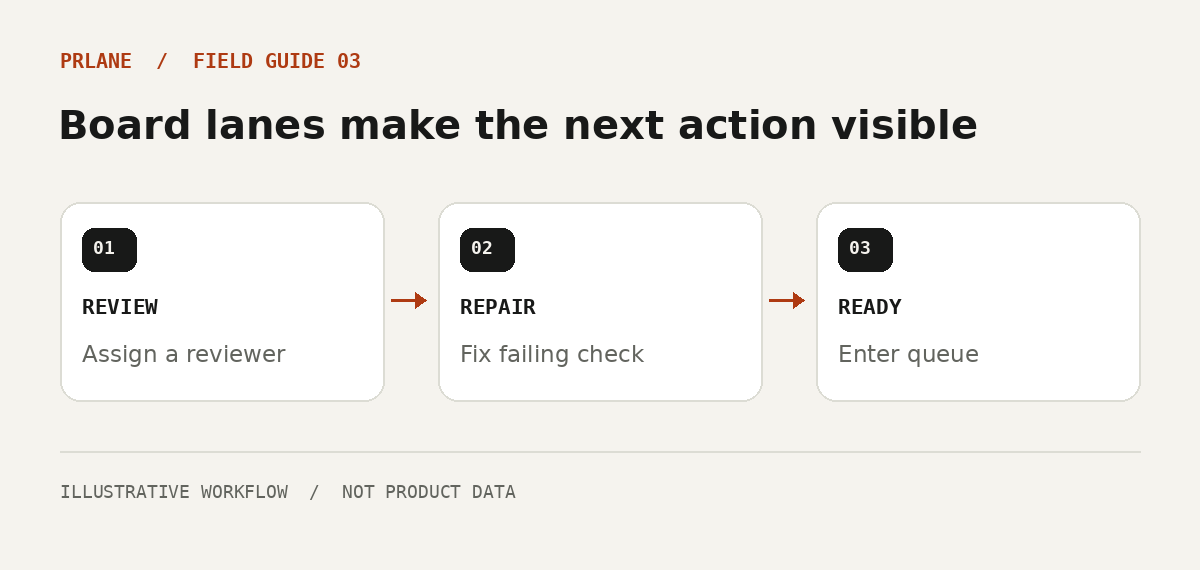
These are process examples, not a requirement to recreate identical columns in every tool. PRLane's readiness view organizes PRs by status and next action, helping teams identify where attention is needed.
Make one blocked card useful
Take a hypothetical mobile checkout change. It has a passing build, but a reviewer asks what happens when a payment attempt times out. Calling it “in review” misses the real work.
A better next action is: “Author to add the timeout behavior and a test; reviewer to revisit after that commit.” The card now describes a handoff instead of a location.
When several blockers exist, identify the next one that can actually be resolved. A reviewer may not be able to evaluate behavior until a failing environment is repaired. Writing down every problem is helpful, but somebody still needs to choose the first move.
Limit work in progress where it hurts
Do not begin with an arbitrary limit for the entire organization. Find the stage where unfinished work routinely stalls.
If reviewers are juggling too many changes, agree on a manageable review commitment. If authors keep starting new tasks while requested revisions sit untouched, make finishing those revisions part of the daily routine.
The point of a limit is to reveal overload and encourage completion. It should not become a way to hide cards, game a metric, or pressure people into approving changes they have not understood.
Run the board from right to left
In a short daily pass, begin with work closest to completion. Check whether ready changes need a decision, then review blocked work, then consider what should enter active review next.
This ordering encourages finishing before starting. Urgent incidents and explicit business priorities can still override it, but ordinary work benefits from a predictable default.
End the pass with owners and next actions. Avoid turning it into a narration of every card. People can read status; the meeting or asynchronous check-in should resolve uncertainty.
Check whether the board changes behavior
After a week or two, ask whether blocked PRs are easier to explain and whether reviewers know what needs their attention. Inspect a few long-lived cards instead of relying only on average cycle time.
If the answers remain unclear, improve the state definitions or handoffs before adding more columns. A smaller board with meaningful decisions is more useful than a detailed board nobody trusts.
Related guide: How to Manage Pull Requests Across GitHub Repositories.
Sign up for PRLane to make your PR fleet easier to triage.