
Measure where pull requests wait, not just when they merge
One average cannot tell you whether work is waiting for review, a fix, a decision, or a safe merge. Start with clear clocks and useful comparisons.
On this page
“Our pull requests take too long” describes a symptom. It does not identify the next action.
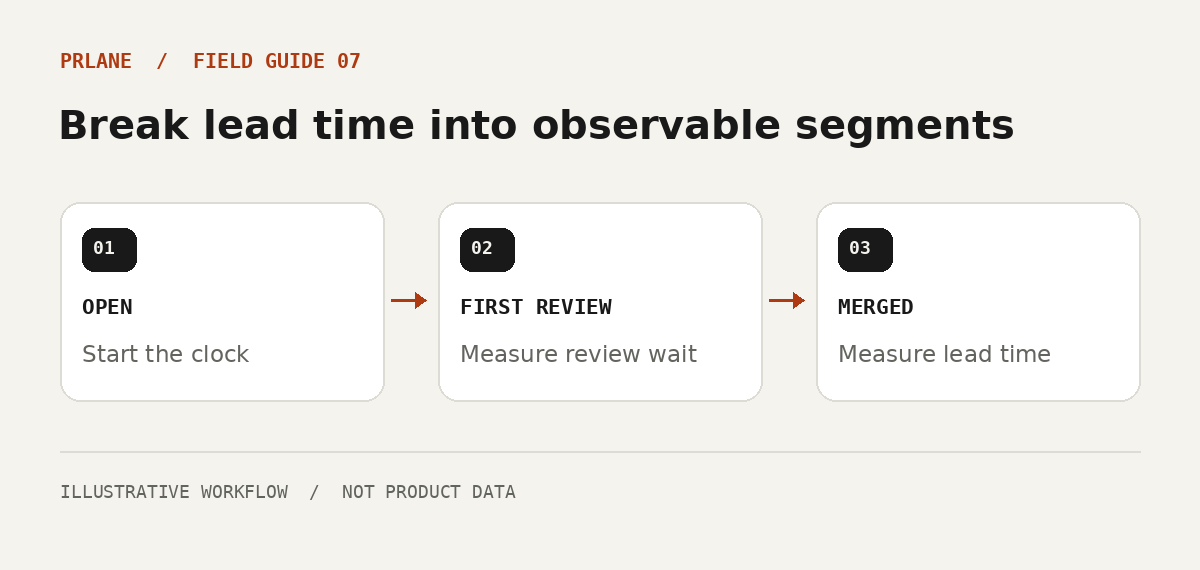
A PR can spend time in draft, wait for its first review, cycle through requested changes, and sit approved before merging. Those intervals have different owners and different remedies. Measuring them separately makes a discussion about speed more useful.
Define the clock before comparing teams
Write down exactly when each interval starts and stops. A practical starting set is:
- Time to first review: from ready-for-review to the first qualifying review.
- Review cycle time: from ready-for-review to the approval needed for merge.
- Approved-to-merge time: from that approval to merge.
- Total PR lifetime: from opening to merge.
These are suggested working definitions, not universal standards. Some teams measure from creation because their tooling lacks a reliable ready-for-review event. That can still be useful if the limitation stays visible.
Decide whether automated comments count as reviews. A formatting bot's immediate response should not make a PR that waits two days for engineering attention appear to have received immediate review.
Separate waiting from active iteration
Consider a hypothetical PR opened Monday morning as a draft. It becomes ready Tuesday afternoon, receives review Wednesday morning, gets a revision that afternoon, and merges Thursday.
Its total lifetime spans several days. But the initial review wait begins Tuesday afternoon, not Monday morning. Treating both numbers as the same metric hides the distinction between work in progress and work awaiting someone else.
Similarly, an approval can become outdated after a new commit. Define how your measurement handles that event. If you measure from the first approval, label it accordingly; do not present the result as uninterrupted time spent ready to merge.
Inspect the distribution and the queue
An average can conceal both a healthy majority and a few severely blocked changes. Show the median alongside an upper percentile when your sample is large enough to make that meaningful. Always include the number of PRs represented.
Then inspect open work separately. A report built only from merged PRs excludes the changes that are still stuck. Ask how long the oldest ready-for-review PR has waited and whether it has a named reviewer.
Small samples deserve restraint. A week containing two unusually large migrations is not enough evidence to conclude that the delivery process has deteriorated.
Pair each metric with a decision
If first-review wait grows, inspect reviewer assignment and availability. If revision cycles dominate, examine task clarity, change size, and the quality of feedback. If approved-to-merge time grows, look at checks, conflicts, branch protection, or an unclear merge owner.
Avoid treating these numbers as a developer leaderboard. Repository responsibilities, risk, and change scope differ. Comparing unlike work can encourage smaller-looking metrics rather than better outcomes.
PRLane brings pull requests across repositories into one fleet view, helping you inspect readiness and identify the next action. Use that operational view alongside consistently defined measurements, rather than assuming any single dashboard number explains the delay.
Choose one recurring bottleneck, make one process change, and compare similar work afterward. The goal is not to make every PR fast. It is to reduce avoidable waiting while preserving the review and testing the change needs.
Related guide: A Practical Kanban Triage Routine for Pull Requests.
Sign up for PRLane to keep the waiting work visible across your repositories.