
Human review and AI review need different jobs
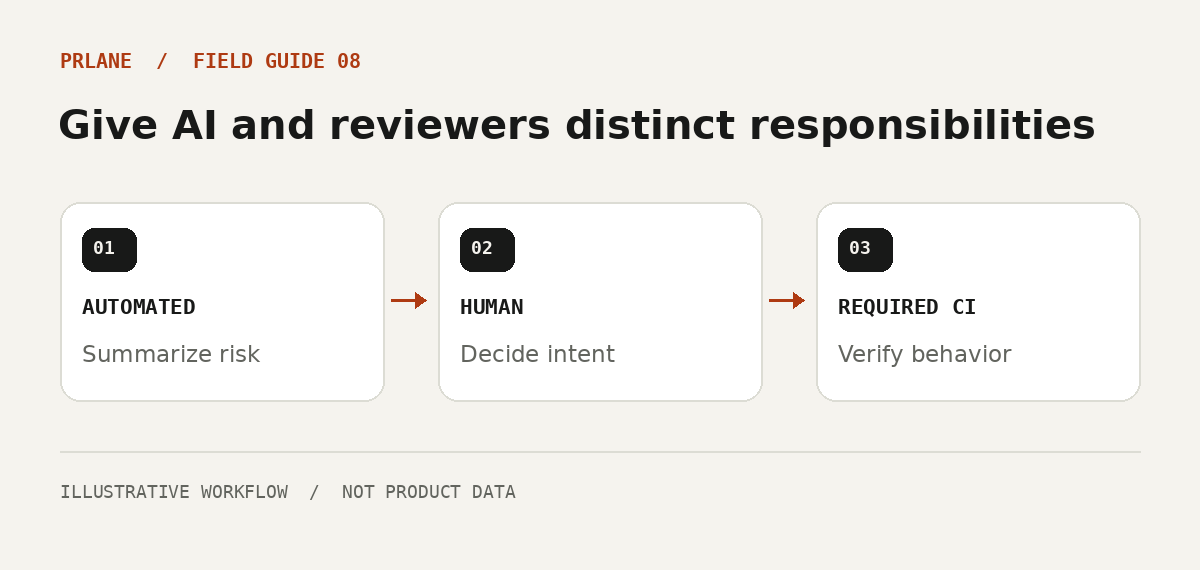
More review output is not the same as more confidence. Give automated checks, AI reviewers, and people distinct responsibilities.
On this page
Adding an AI reviewer to a repository can produce more feedback without making the merge decision any clearer. A PR now has test results, a generated review, several comments, and a person wondering which signals matter.
The answer is not to choose one reviewer for every job. Define what each part of the process is responsible for, and what evidence must exist before a change lands.
Give deterministic checks the repeatable work
Use automated checks for requirements that can be expressed and evaluated consistently: whether the project builds, whether an expected behavior passes a test, or whether a formatting rule is satisfied.
A passing check proves only what that check actually evaluates. It does not establish that the product decision is right or that an untested interaction is safe. Keep that boundary explicit when deciding what “green” means.
For example, a test might prove that a discount calculation returns the expected total for several inputs. It cannot decide whether the business should offer that discount to a particular customer group.
Ask AI review for specific analysis
An AI reviewer is more useful with a focused assignment than a request to “review everything.” Ask it to trace a changed authorization path, look for missing error handling, or compare the implementation with the stated acceptance criteria.
Treat its output as findings to evaluate, not a certificate of correctness. A suggested defect may be real, incomplete, or mistaken. Request the relevant code path and a concrete failure scenario so someone can assess the claim.
Likewise, a quiet review is not evidence that no defects exist. Important context may live outside the diff, in a deployment configuration, a product decision, or an integration contract.
Reserve human attention for consequential judgment
People should own ambiguous requirements, meaningful tradeoffs, and decisions whose consequences extend beyond the code. That includes whether a behavior is desirable, whether a migration plan is acceptable, and whether the evidence is sufficient for the risk involved.
Not every change needs the same depth of manual review. A narrowly scoped copy correction and a permissions change should not automatically follow identical review paths. Define risk-based expectations in advance rather than improvising an exception because the queue is long.
For an authorization change, a useful review package might include the intended access rule, tests for allowed and denied cases, an explanation of existing behavior, and a named human reviewer responsible for the decision.
Make disagreement actionable
If an AI finding conflicts with a passing test, investigate the scenario. The test may not cover it, or the finding may misunderstand the code. Add a focused test when that is the clearest way to resolve the question.
If a human rejects a finding, record the reason when it could help a future reviewer. Avoid collecting unresolved comments that nobody owns. Each blocking concern needs a next action and a person accountable for resolving it.
Keep the merge decision separate
Review is evidence gathering. Merge is an action taken on a particular commit under current repository rules. A later push can change what was reviewed, so check that the evidence still applies before merging.
PRLane helps teams see PR readiness and coordinate work across a growing fleet of changes. Use that visibility to direct attention, not to remove accountability. The team still owns its acceptance criteria, branch protections, and consequential decisions.
Related guide: How to Hand Failing CI to a Coding Agent.
Sign up for PRLane to organize the work around clearer review and merge decisions.