
Merged is not deployed: keep the last handoff visible
A merged pull request can still be waiting for a build, a deployment, a flag, or verification. Track those states separately so finished code does not disappear.
On this page
The pull request is merged. The issue is marked done. A teammate asks whether customers can use the change, and nobody can answer without checking another system.
That gap is common because “merged,” “deployed,” and “released” describe different events. Treating them as synonyms hides unfinished delivery work.
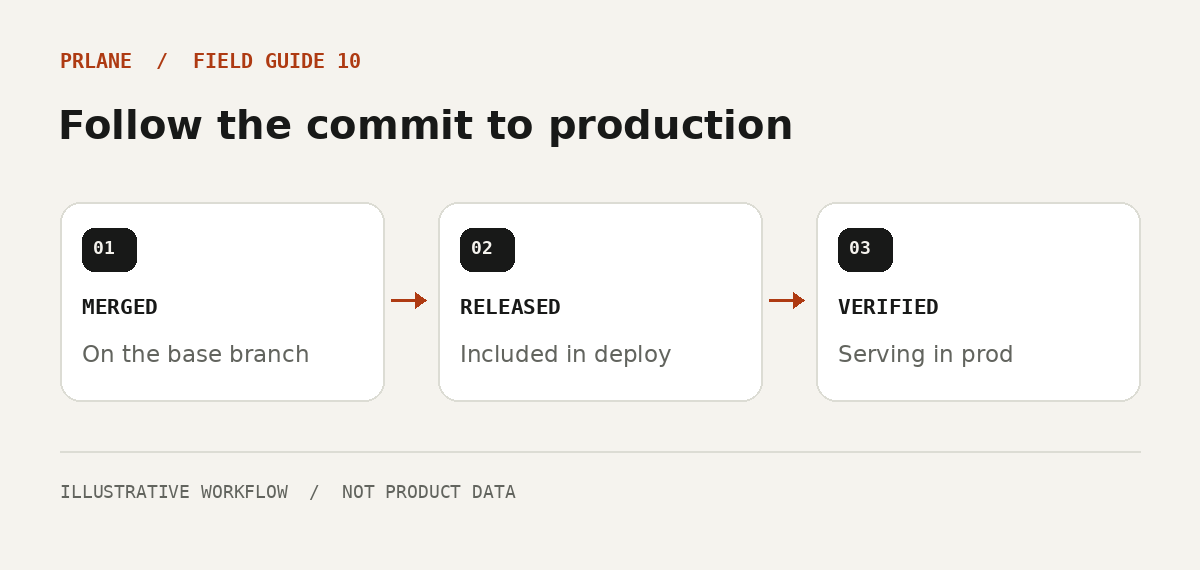
Define the three states
Merged means the change has entered the target branch. It says nothing by itself about which environment is running it.
Deployed means a particular build or revision has been installed in a particular environment. A staging deployment is not a production deployment, and a preview is not proof that production contains the change.
Released means the intended audience can use the behavior. A deployment may include a disabled feature flag, a restricted rollout, or functionality waiting on another prerequisite.
Your team may use different names. What matters is that each label has a clear definition and evidence that supports it.
Keep a lightweight delivery ledger
You do not need a complex process to make the handoff visible. Start with a record connecting a change to:
- Its PR and merged revision.
- The build or release that includes it.
- The target environment and deployment outcome.
- Any flag, rollout, or operational prerequisite.
- The owner of verification and the evidence of completion.
Keep facts separate from intentions. “Planned for Thursday” is useful, but it is not the same as “deployed Thursday.” A deployment that started and then failed should not appear as successful delivery.
Follow the artifact, not just the branch
Imagine a fix merges after a production build has already been created. That build deploys successfully, but it does not contain the fix. Looking only at the current main branch could lead someone to report the change as live incorrectly.
Verify which revision or artifact was actually deployed. If the release process uses cherry-picks or separate release branches, the connection may require additional tracking. Do not assume that a merge into one branch guarantees inclusion in another.
The same distinction matters after a rollback. A previous successful deployment record does not prove the change remains in the environment now.
Make the next action explicit
An unreleased change should have a reason, not just an age. It might be waiting for a release window, a migration, documentation, a feature flag decision, or a fix for a failed deployment.
Assign an owner to that next step. “Engineering is handling it” is less useful than a named person responsible for verifying production behavior after the deployment completes.
For a small bug fix, verification may be a targeted check of the affected workflow. For a broader rollout, it may involve agreed monitoring and a staged audience. Choose evidence proportional to the consequence of being wrong.
Report progress without overstating it
Use precise updates: “Merged and waiting for the production release,” or “Deployed to production; the feature remains disabled.” These statements help product, support, and engineering coordinate without reconstructing the entire delivery history.
PRLane's fleet view distinguishes merged work from work that still needs attention, including an unreleased view. Pair that visibility with your deployment system's actual evidence rather than treating a PR status as a substitute for environment verification.
The final handoff is part of delivery. Keeping it visible helps the team answer the question that matters: which changes have actually reached the people they were built for?
Related guide: Measure where pull requests wait, not just when they merge.
Sign up for PRLane to keep your pull request fleet and its delivery handoffs in view.