
Managing Merge Conflicts Across Busy Repositories
Resolving a conflict means preserving intent, not choosing whichever side makes the editor quiet.
On this page
A shared type changes in one branch while another branch updates the code that consumes it. A third branch reorganizes the same files. By the time the work is reviewed, the conflict has become a coordination problem as much as a text-editing problem.
Busy repositories need a consistent way to surface conflicts, assign decisions, and verify the combined result. Across several repositories, teams must also distinguish a Git conflict from a compatibility dependency that Git cannot detect.
Separate textual conflicts from behavioral conflicts
A textual conflict occurs when changes cannot be combined automatically. A behavioral conflict can remain even when the files merge cleanly: one service expects a field that another service no longer returns, for example.
That distinction matters during triage. Removing conflict markers does not establish that the resulting program behaves correctly. Likewise, a clean merge does not prove that independently deployed components remain compatible.
PRLane's fleet view surfaces conflicting PRs and supports handing conflict context to coding agents. The team still needs to decide which behavior the combined change must preserve.
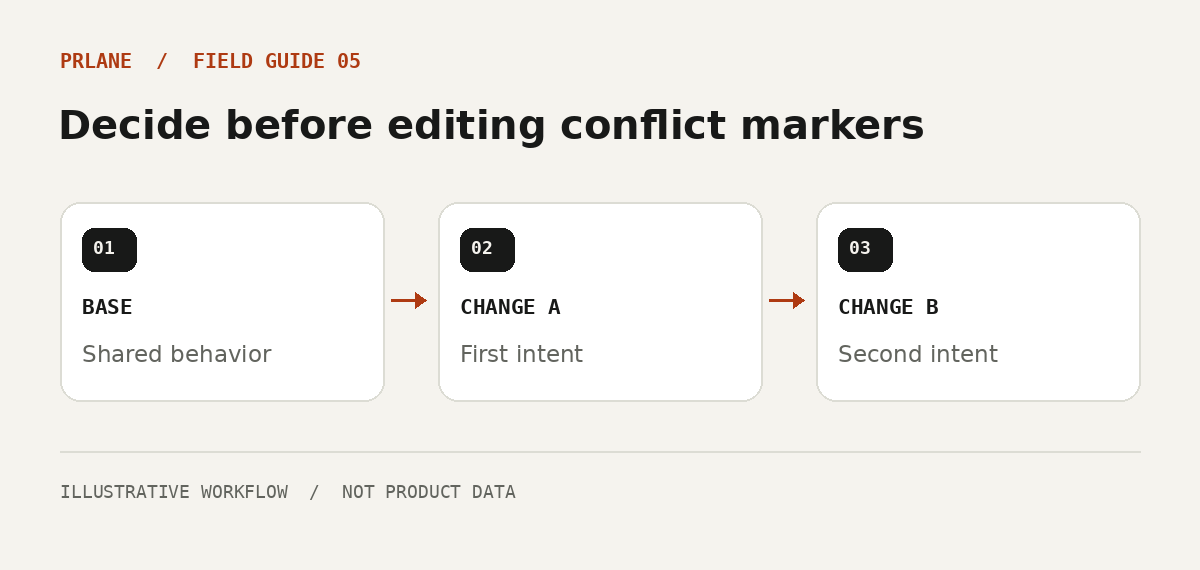
Resolve intent before editing the overlap
For a hypothetical account-settings change, suppose one PR renames a preference while another adds a new default for it. Before choosing either version, answer these questions:
- Is the rename part of an agreed API change?
- Must older clients continue to work?
- Does stored data need a migration or compatibility layer?
- Which test should capture the intended result?
Ask the authors or relevant owner when the answers are unclear. A conflict involving two reasonable implementations is not a guessing contest. Document the decision so the eventual reviewer can understand why the resolution differs from either original branch.
Choose an integration order deliberately
When several changes touch the same area, identify whether one establishes a foundation for the others. A small compatibility change may need to land before a larger refactor. Independent work may be better separated than repeatedly updated as one tangled batch.
Write down the order and assign an owner for updating dependent work. Follow the repository's established merge or rebase workflow; do not rewrite a shared branch casually just to produce a cleaner-looking history.
Across repositories, maintain explicit links between dependent PRs. Also record deployment requirements. “Merge API first” may be insufficient if the client depends on that API version already being deployed.
Verify the combined behavior
Review the affected code after resolving the conflict, including nearby logic that merged automatically. Check imports, generated artifacts, configuration, and tests connected to the change.
Run targeted checks that exercise the contested behavior, followed by the required repository checks. For cross-service changes, use integration or compatibility tests where available. If there is no practical automated coverage, describe the manual verification and its limitations rather than implying certainty.
A coding agent can help implement a chosen resolution, but it should receive the same intent, constraints, and verification requirements as a human collaborator. Require an explanation of meaningful choices, not only a statement that the branch now merges.
Reduce the next round of conflicts
Keep overlapping changes small, announce significant shared-interface work, and close obsolete branches after confirming they are no longer needed. Repeated conflicts in the same area may reveal unclear ownership or changes that should be coordinated earlier.
Related guide: Merge Queues: Keeping Approved Work Moving as Main Changes.
Sign up for PRLane to keep conflicts visible across your pull request fleet.